

As well as aircraft and engines, we have much more on display for you to explore. View some of our additional exhibits below.
Additional Exhibits

No admission charge
We thrive on donations
Featured Exhibit
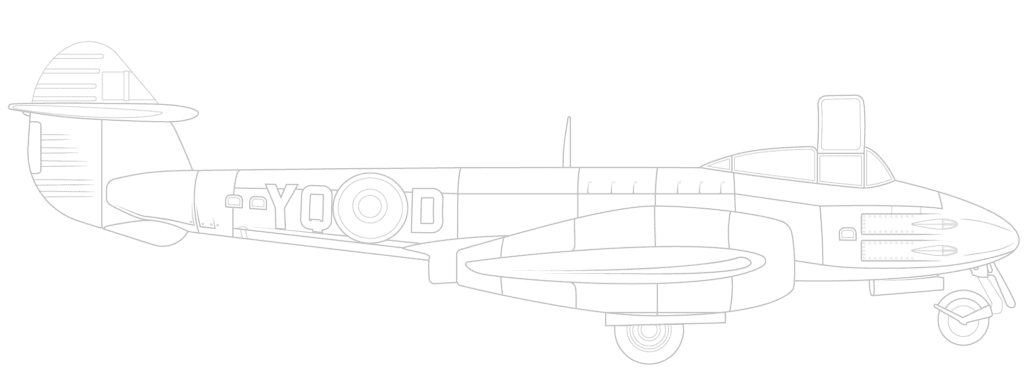
Meteor F3 EE425 Cockpit
The Gloster Meteor was the first and only operational jet fighter to actually enter combat in WWII for the Allies. Replacing the F1, the F3 had Rolls-Royce engines, a revised canopy style and increased fuel capacity.
210 F3’s were produced and were first introduced on the Belgian front in January of 1945 to intercept the Me 262, however by that time the Luftwaffe was sufficiently weakened that the F3’s never engaged the 262 in combat.
They were mostly used in reconnaissance and air-to-ground support activities.
This cockpit is from the third oldest F3 Meteor and was purchased and presented to the Museum by Richard Greenwood, the son of Eric Greenwood, Chief Test Pilot at Gloster Aircraft Company, 1945-1946.

It’s believed to be the oldest surviving jet cockpit in Britain

Model Planes
Most of the models at Jet Age Museum are in three cabinets in the North East corner of the main display hall near the entrance.
The Trident Cabinet puts the Museum’s Hawker-Siddeley Trident forward section into the context of airliner history using 1/144 scale models
The Gloster Cabinet next to it uses 1/72 scale models to represent the aircraft mass produced at Hucclecote from the 1930s to the 1960s.
The floor of the Vulcan Cabinet (pictured) puts the Avro Vulcan cockpit into the context of other nuclear bombers and the missile systems that supplanted them – mainly in 1/144 scale. The shelves above them recall the history of 501 County of Gloucestershire Squadron and the story of Britain’s air defences from 1957 to the present day.
At right angles to these three cabinets is the Rotating Display Cabinet, optimised for 1/72 scale models and featuring the Airfield Embankment diorama.
In the North West corner, a diorama of an Airspeed Horsa glider and Short Stirling tug aircraft enhances the Airborne Forces display.
Elsewhere, a 1/48 scale display near the Armstrong-Whitworth Meteor Night Fighter explores the evolution of early British jet aircraft.
1/24 scale models also help put both the Hawker Hurricane and Hawker Typhoon in context.

Firestreak Missile
As used by the Javelin fighter aircraft, displayed on its handling trolley.
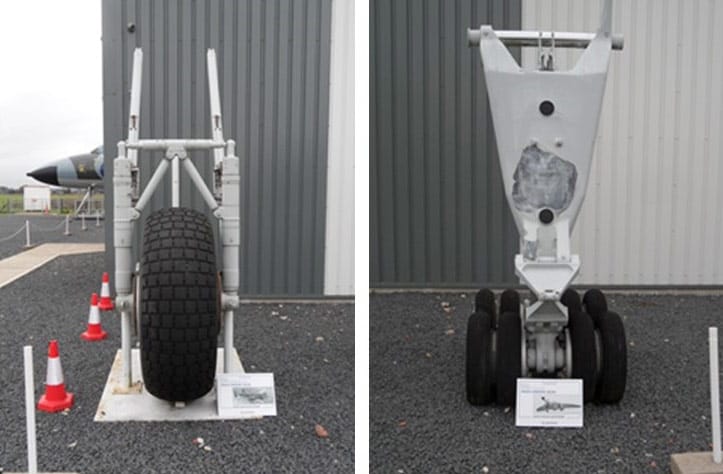
Landing Gear Legs
Avro Shackleton and Vulcan main landing gear legs. Manufactured by Dowty Landing Gear.

Unibus Scooter
Just after the First World War, the Gloucestershire Aircraft Company diversified into the production of a motor scooter, which was marketed under the name of Unibus. Built at the firm’s Sunningend Works in Cheltenham in the early 1920s, the machine was designed by Harold Boultbee, who was an aircraft designer. A fine job he made of it too. The machine was one of the best and most advanced designs of that era. The Unibus on display at the museum is in working order.

Airfield Fire Cart
Most likely manufactured before World War 2.

Factory Clocking In Clock & Whistle
Gloster Aircraft Company wooden clock for staff clocking in and out at the factory, manufactured by Gledhill Brook, mechanism and case restored. Restored large steam factory whistle/hooter, sounded to mark the start and end of the day.
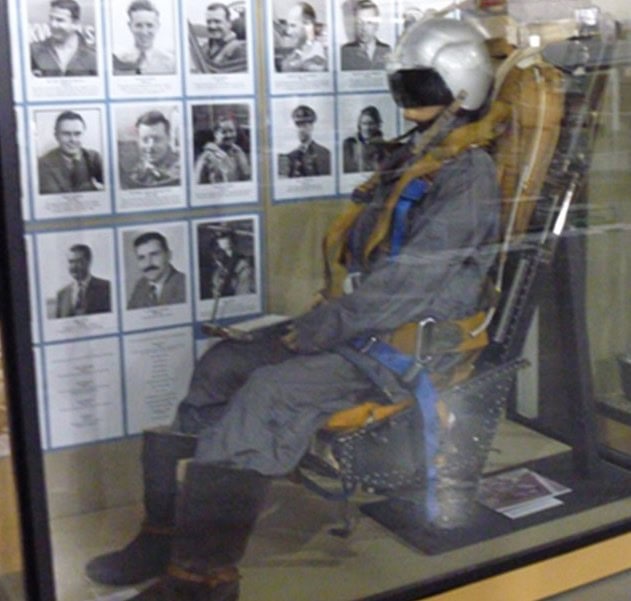
Pilot Display
Display of dummy pilot with uniform and ejection seat, and photos / short biographies of Gloster pilots in the background.
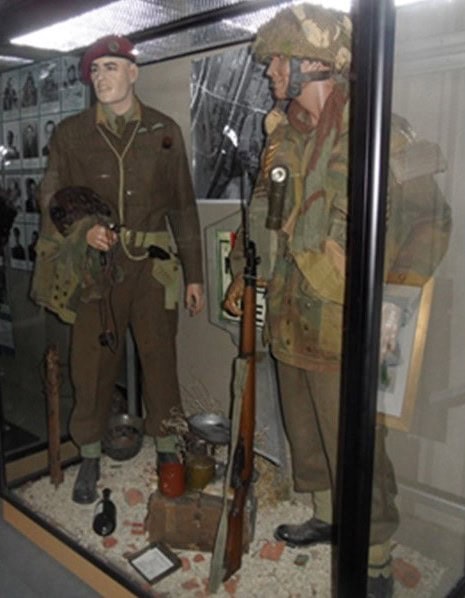
Airborne Forces Display
Gloucestershire played a major part in airborne operations in WW2.
Both RAF Down Ampney and RAF Fairford were embarkation airfields for the invasion of Europe.

Hispano Cannon
This Hispano 20mm aircraft cannon was recovered from Typhoon 1b JR516 aircraft which caught fire / crashed on the 5th August 1944 at Taynton / Tibberton, between Huntley and Newent in Gloucestershire. The HS.404 was an autocannon produced by Hispano-Suiza and derivates and was widely used as both an aircraft and land based weapon in the 20th century by French, British, American and numerous other military services, particularly during the World War 2.

Turboprop
This turboprop blade has a significant place in the history of the Jet Age.
The world’s first turboprop aircraft was a modified Gloster Meteor used as a testbed for the Rolls-Royce Trent engine.
With five-bladed propellers fitted to its two modified Derwent jet engines it pioneered the type of propulsion used by many short and medium range airliners today.
Meteor I EE227 had seen RAF service before being transferred for the new engines to be installed.
It first flew on September 20, 1945, with Gloster’s chief test pilot Eric Greenwood at the controls.

C130J Lockheed R391 Hercules Propeller
The propeller has a 13.5ft diameter.
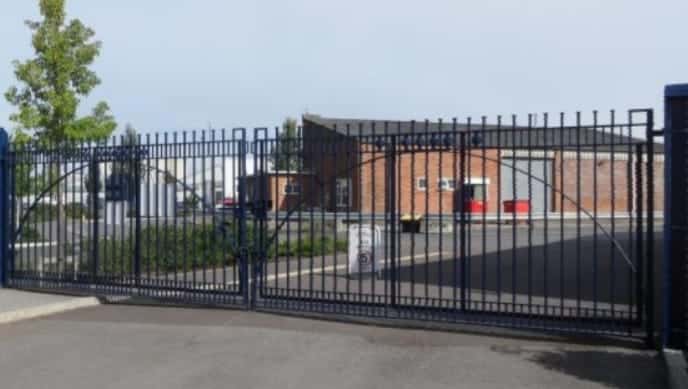
Factory Gates
The blue gates at the entrance to the museum were once one of two sets of gates that guarded the Gloster Aircraft Company factory
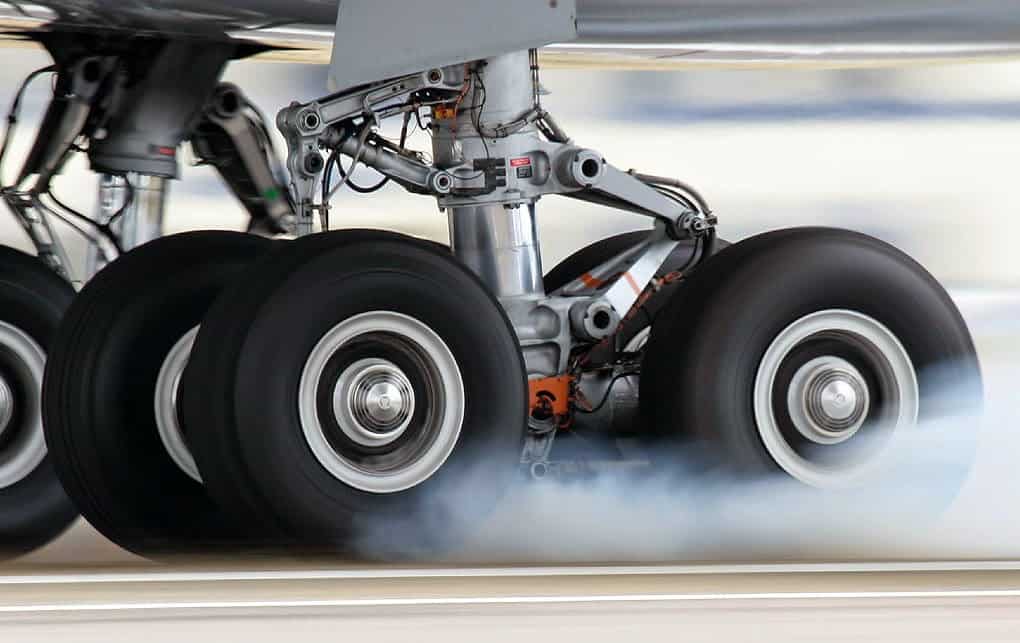
Landing Gear
The Gloucestershire factory of Dowty (then Messier-Dowty, now SAFRAN) has designed, developed and produces landing gears for both civil and military aircraft for over 100 years.
On landing, this equipment is the primary means of ensuring safety – transferring lift from the wings to support from the ground, which for an airliner like the Airbus A330 weighing almost 200 tonnes means the design has to be good! Around 18,000 Airbus A320 series aircraft have been sold around the world – that’s 36,000 individual main landing gears contributing to Gloucestershire’s economy.
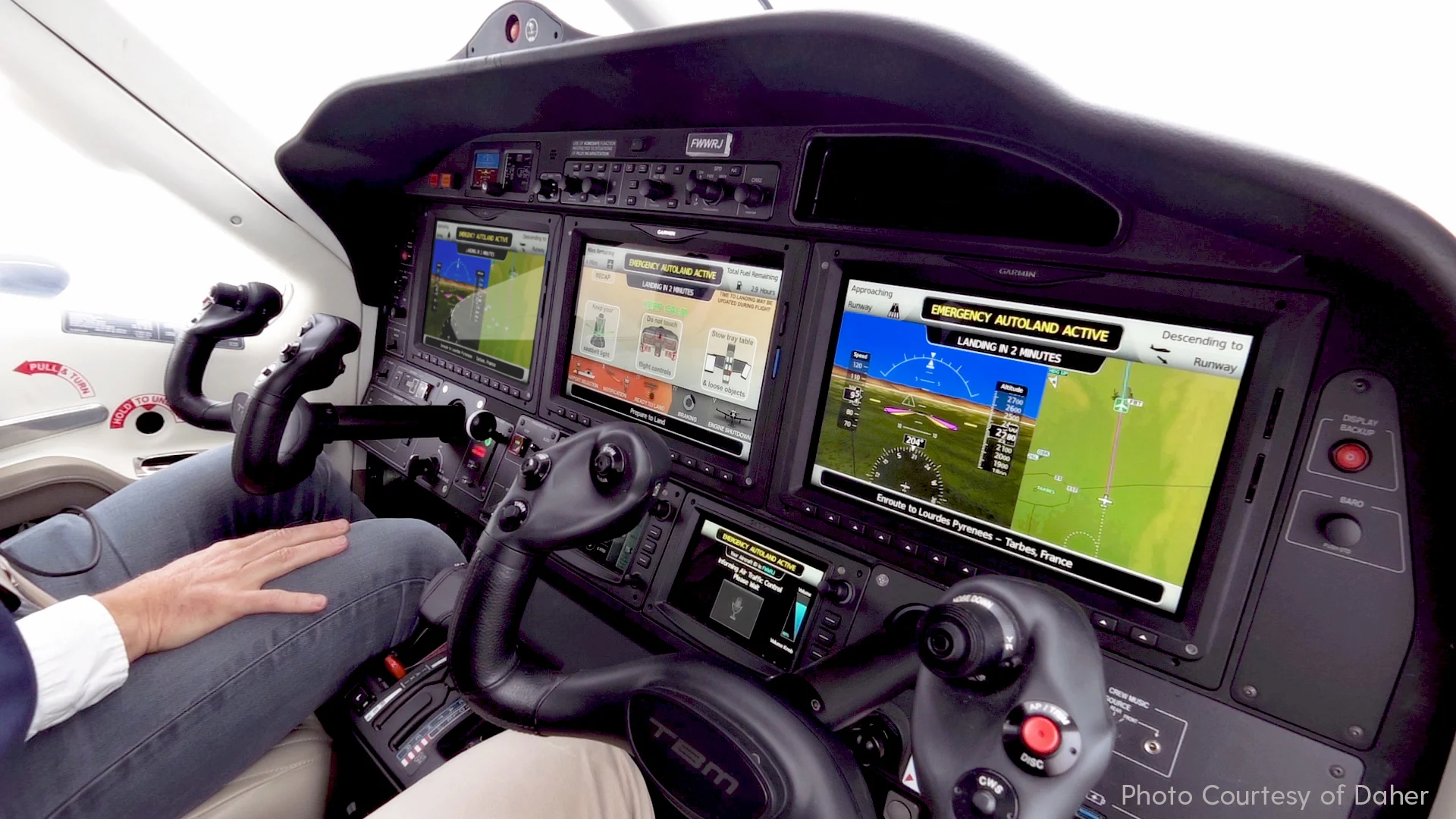
Systems
The Hawker Siddeley Trident was the first airline to have an automatic ‘blind’ landing system. That means the aircraft can land without the pilot intervening. This ground-breaking system was designed, developed, tested and built by the Gloucestershire firm of Smiths Industries.
To ensure safety, a triplex system with no common elements was used, so that a failure in one of the three channels could be detected and that channel eliminated. Today such systems are common on many types of military and civil aircraft.

Airfield
The Gloucestershire airfield at Staverton was first operational in 1931. The RAF took over operations there in 1936 mainly used for flying training. During the WWII a number of units and flights were based at the airfield including No 44 group command which operated between 15 August 1941 and 9 August 1946. Post war the site migrated to commercial use where it is operational today as Gloucester Airport.
Plan Your Visit

Opening Hours: Standard hours are Saturday – Sunday 10am – 4pm. View additional days.
Admission: There is no charge for admission to the Museum site, to the building or any exhibits, but donations to help meet our running costs and to fund our expansion plans are most definitely welcome! Click here to donate.
Find us: Meteor Business Park, Cheltenham Road East, Gloucester, GL2 9QL


